Physical Address
304 North Cardinal St.
Dorchester Center, MA 02124
Physical Address
304 North Cardinal St.
Dorchester Center, MA 02124

European Capital of Culture 2027
European Capital of Culture 2027
The Liepāja Symphony Orchestra is the oldest in the Baltic States. For most of its existence — stretching back to 1881, when the city’s first philharmonic was founded — it performed in spaces that were functional but acoustically wrong. A concert hall worthy of the orchestra took 134 years to arrive.
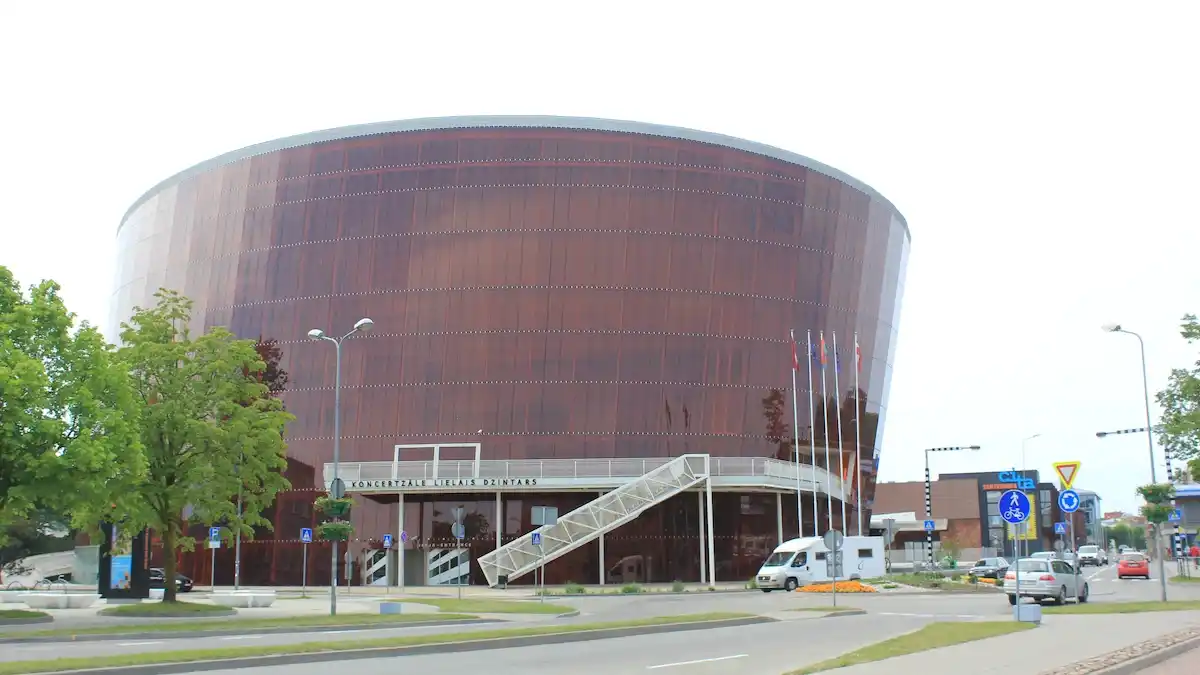
The Great Amber Concert Hall opened in 2015. What the city got was not a modest community arts centre but a 14,126-square-metre, eight-floor structure designed by Austrian architect Volker Giencke, with acoustics engineered to standards applied in the finest concert venues in Europe.
For a city of 70,000 people on the Baltic coast, this is an unusual building to have.
Giencke’s concept starts with the material. Baltic amber — fossilised resin washing onto beaches along this coastline for centuries, trading commodity and regional identity since antiquity — gave him both his form and his palette.
The building is cone-shaped and slightly contorted, leaning in a way that suggests something organic rather than engineered. The facade is amber-tinted and translucent in sections — warm-toned in ways that shift noticeably at different times of day. It was designed to resemble a traditional hat Lativan ladies would wear.
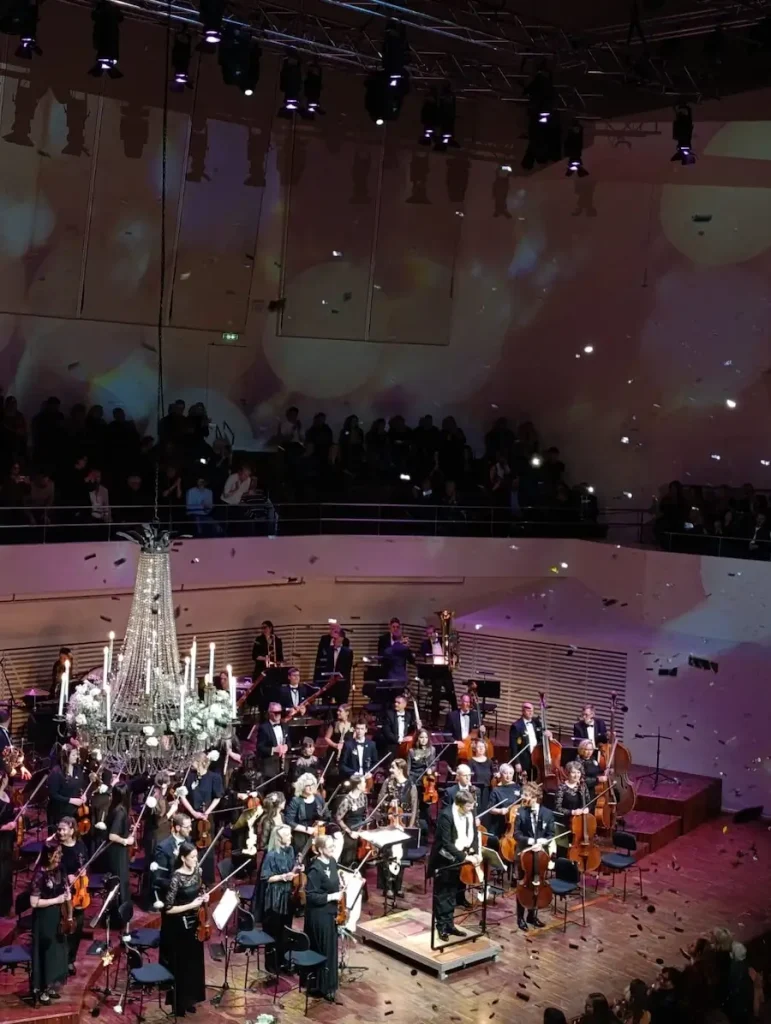
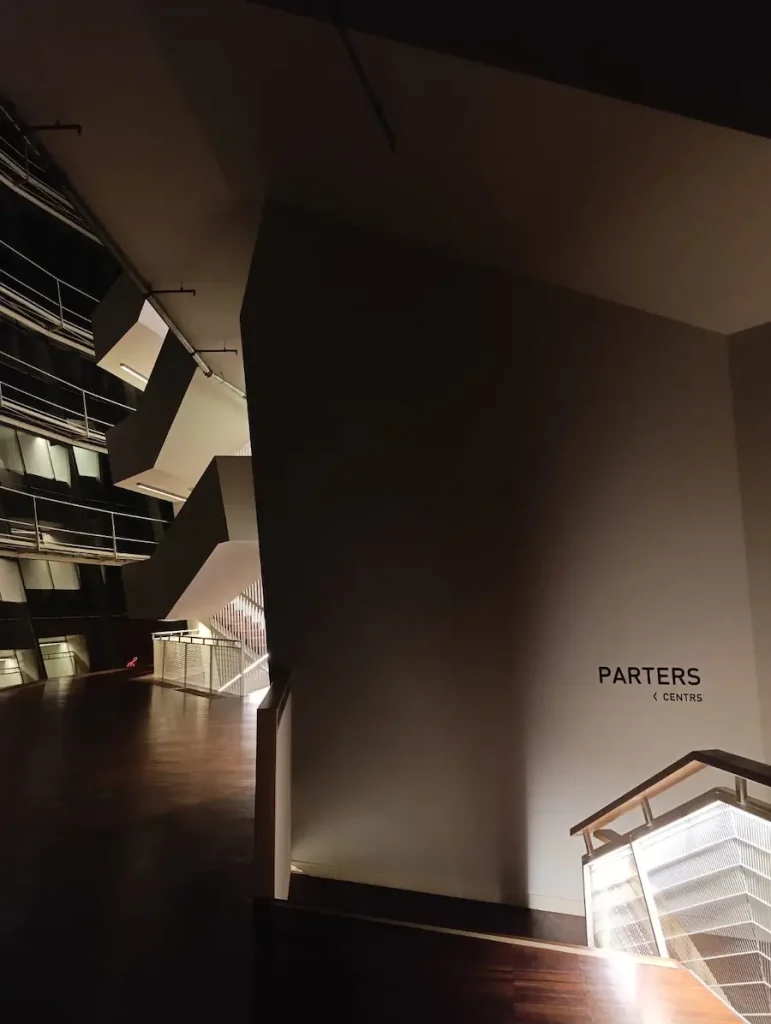
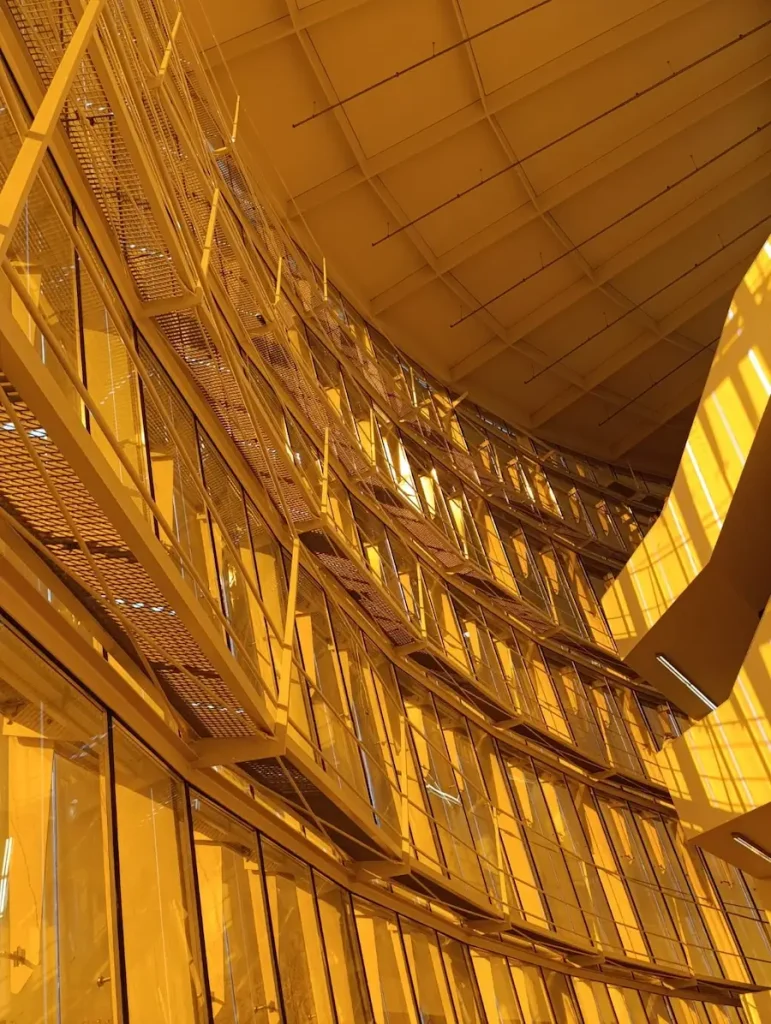
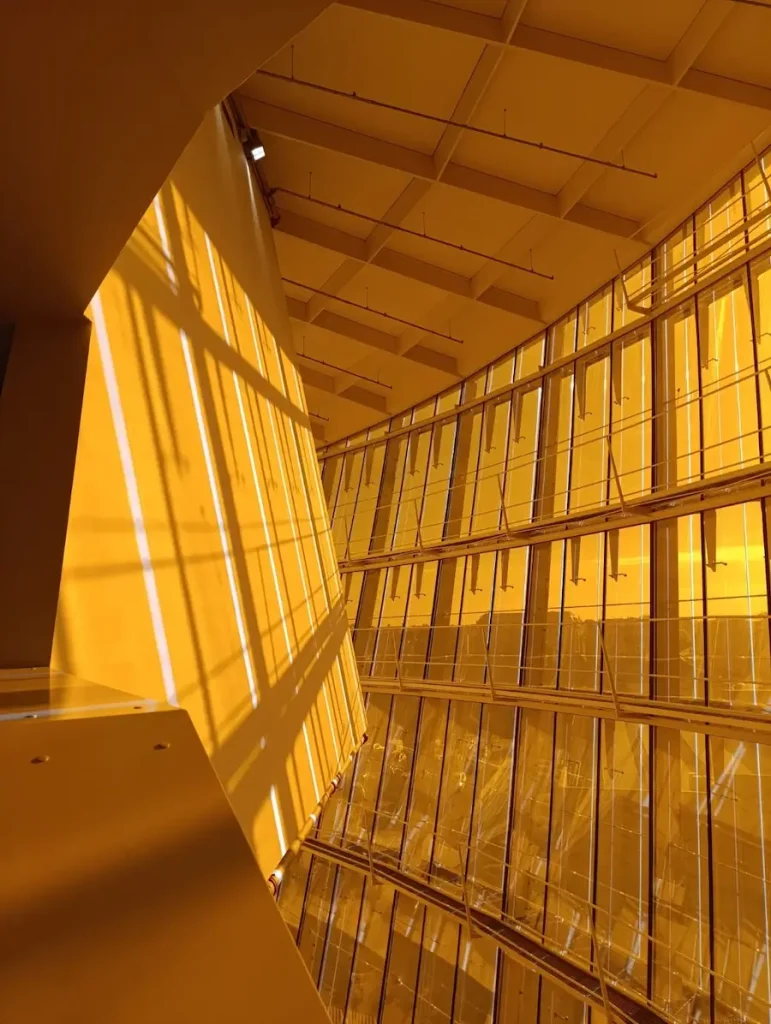
Fourteen mirror-finished reflective tubes run through the structure, drawing natural light into the interior. The effect inside the main hall is of a space that seems both enclosed and lit from somewhere you cannot immediately locate.
The lighting design was handled separately by Professor Christian Bartenbach of Austria, working alongside rather than for the architect. These are not details that arrived by accident.
The acoustic design was handled by Karlheinz Müller of Müller-BBM, a Munich-based firm with work in concert halls across Europe. The principle they applied is the vineyard layout — terraced tiers that allow audiences to surround the performers rather than face them in rows.
Vineyard halls produce a more spatially complex listening experience than traditional shoebox designs. Instruments heard from the side sound different from instruments heard from behind. The effect is immersive in a way that flat-stalls layouts don’t achieve.
At the Great Amber, reverberation times reach 1.8 to 2.0 seconds when the hall is full, increasing towards the lower frequencies. That warmth in the bass register is deliberate — it suits the orchestral and choral repertoire the hall predominantly hosts.
The building contains three distinct performance spaces, each with its own acoustic tuning and function.
The Great Hall seats 1,000. This is the main orchestral space — where the Liepāja Symphony Orchestra performs its season, where visiting international companies appear, and where the highest-profile 2027 ECoC events are programmed.
The Chamber Hall seats 200. Smaller-scale concerts, recitals, and chamber music programmes use this space. The acoustic here is drier and more intimate — suited to repertoire that would be overwhelmed in the main hall.
The Experimental Stage — formally the Liepāja Theatre Small Hall — accommodates 120. This is where new work, installation-based performances, and more experimental programming finds its room. The Civita Nova Art Space on the ground floor extends the building further into exhibitions and events.
The Liepāja Symphony Orchestra traces its continuous history to 1881, when the city’s first philharmonic was established — the oldest such claim in the Baltic States.
The orchestra was granted professional status in 1986, becoming the second professional symphony orchestra in Latvia. For decades before that, and for years after, it performed in venues that were adequate but never purpose-built. The Great Amber changed that.
Since 2015, the orchestra has had a hall designed for its specific sound, size, and repertoire. That this happened in a city the size of Liepāja, rather than in Riga, is something the city is quiet about in a way that suggests it is not quiet about it at all.
The Great Amber is where Liepāja’s ECoC year concentrates its highest-profile international commissions. The hall’s programme in 2027 is distinct from the rest of the city’s offering: larger scale, higher production values, international artists who wouldn’t normally route through Latvia.
Sun & Sea — the Lithuanian opera-performance by Rugilė Barzdžiukaitė, Vaiva Grainytė, and Lina Lapelytė — arrives from 8 to 11 April for its Latvian premiere. The work won the Golden Lion for Best National Participation at the 2019 Venice Biennale.
It involves a cast of singers and performers lying on a sandy beach under artificial lights, singing quietly across an extended duration. It is not a conventional opera. The Great Amber’s scale and acoustic restraint suit it better than most venues would.
Europa Cantat arrives for the week of 9 to 15 August. The 22nd edition of Europe’s major amateur choir festival brings around 3,000 singers to Liepāja, with the Great Amber as its central venue and more than 30 workshops programmed alongside the main festival concerts.
Malian vocalist Oumou Sangaré performs on 11 October as part of the hall’s ongoing international series. The Great Amber runs this kind of programming independently of the ECoC designation — the 2027 year amplifies it rather than replacing it with something new.
The hall also marks its own tenth anniversary in 2025, leading into a full festival programme that carries into the ECoC year. Liepāja is treating the anniversary and the designation as a single extended occasion rather than two separate events.
Liepāja is Latvia’s third-largest city, with around 70,000 residents on the Baltic coast between the sea and Lake Liepāja. The Great Amber sits near the city centre, within walking distance of the Holy Trinity Cathedral and the Liepāja Theatre.
The city’s cultural character runs deep and contradictory. The oldest Baltic symphony orchestra shares a city with Latvia’s largest music festival. The most rigorous acoustic design in the region sits in a place famous for its wind and its rock bands.
Liepāja holds the European Capital of Culture designation in 2027, alongside Évora in Portugal and České Budějovice in the Czech Republic. The programme — named (un)rest — runs throughout the year across more than 500 events. Full listings and tickets are at liepaja2027.lv.
Liepāja is a three-hour drive or bus journey from Riga; LUX Express runs regular coach services. The Great Amber Concert Hall is central and walkable from most of the city’s accommodation. For help planning a visit, liepajaguide.com covers accommodation, transport, and practical city information.
Picture: Great Amber Concert Hall — Andrzej Otrębski, CC BY-SA 4.0 via Wikimedia Commons.