Physical Address
304 North Cardinal St.
Dorchester Center, MA 02124
Physical Address
304 North Cardinal St.
Dorchester Center, MA 02124

European Capital of Culture 2027
European Capital of Culture 2027
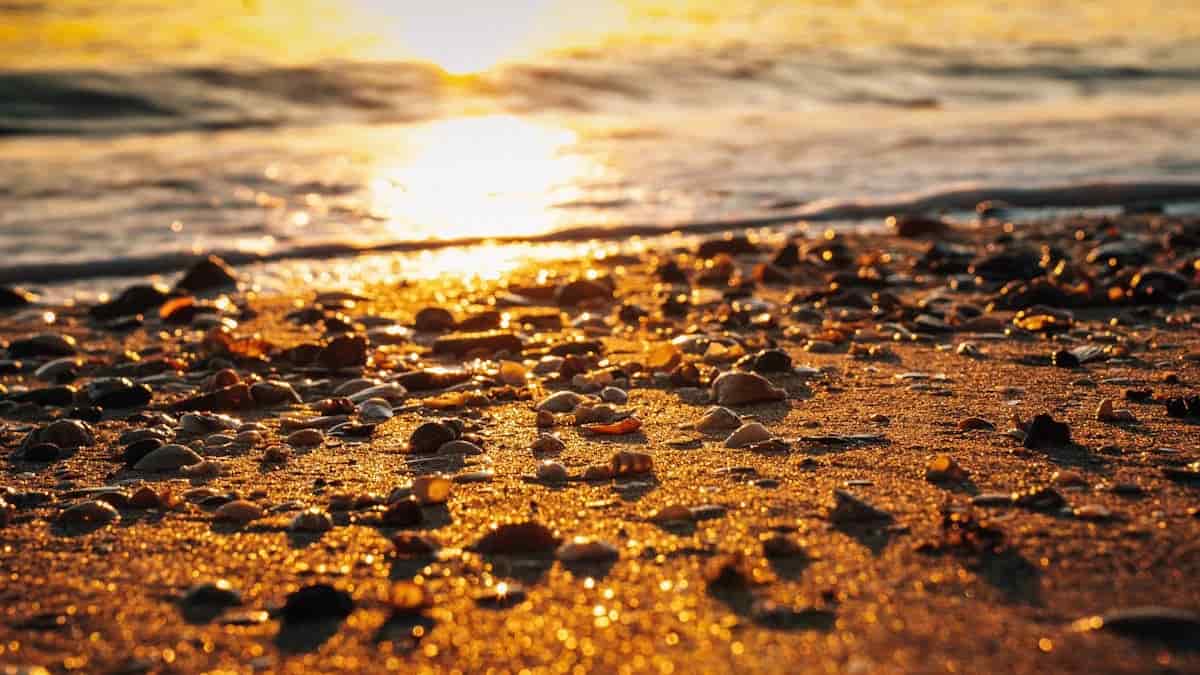
The Greek word for amber is ἤλεκτρον — elektron. When ancient Greeks rubbed amber and noticed it attracted dust and feathers, they named the effect after the stone. Two thousand years later, that effect became electricity. The stone and the force share a root.
That etymology is the starting point for ElektrON – The Future of Amber, an international symposium taking place across Liepāja and Pāvilosta on 12 and 13 June 2026 as part of the Liepāja 2027 European Capital of Culture programme. The premise is deceptively simple: what does amber mean now, and what could it mean next?
The symposium splits across two days and two venues. On Friday 12 June, German artist Lisa Rave opens proceedings at the Art Research Laboratory (MPLab) of RTU Liepāja Academy on Kūrmājas Prospekt. Rave’s practice sits at the intersection of art and anthropology — she works with the geological environment and what human culture makes of it. The evening includes a screening of her 2014 essay film Europium, which examines rare-earth mining and the materials that power contemporary technology.
On Saturday 13 June, the symposium moves to the Pāvilosta Cultural Center, a small coastal town about 40 kilometres north of Liepāja. From 13:00, a programme of presentations examines amber from multiple angles: cultural history, contemporary art, material science, and the politics of fossil resources. Speakers include Zane Cērpiņa (artist and curator, based in Norway), Barbara Ābele (designer and professor at the Latvian Academy of Arts), Paula Vītola (new media artist and researcher), and Sigita Talačkiene, director of the Palanga Amber Museum in Lithuania.
At 16:00, eight artists from the associated PAiR (Pāvilosta Artist in Residency) programme present their research. They come from Germany, Latvia, Lithuania, Norway, Hong Kong, and Canada: Michael Saup, Mikus Svikulis, Ieva Viese, Zane Zelmene, Aistė Ambrazevičiūtė, Kim Hankyul, Trevor Yeung, and Helen Liene Dreifelds. What they’ve made during the residency process will be shown here before the full exhibition opens at the Liepāja Museum in January 2027.
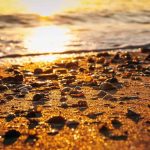
Amber is found across the Baltic coast, washed up on beaches after storms. It is resin — fossilised tree resin from forests that no longer exist, some pieces 44 million years old. It is also, in the context of this symposium, a fossil resource. And fossil resources, in 2026, come with an argument attached.
The organisers — the Association ASTE (Art, Science, Technology, Education), working with the VV Foundation’s Pāvilosta residency — frame the project as a critical re-examination of amber’s role. The Baltic coast has defined itself through amber for centuries: in trade, in jewellery, in cultural identity. The symposium asks whether that identity is worth scrutinising alongside the celebration.
The choice of Lisa Rave’s Europium as the opening film is telling. It is not about amber specifically — it is about rare-earth mining in general, and the gap between the materials that make modern electronics possible and the environmental cost of extracting them. The signal is clear: this is not a celebration of a beautiful stone. It is an examination of what beautiful things cost, and who pays.
The title ElektrON holds the tension in a single word. Amber gave us the concept of electricity. Electricity now runs on materials extracted in ways that are repeating the same extractive logic. The symposium asks where amber fits in that chain — as symbol, as material, as warning.
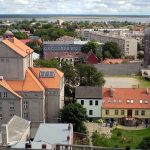
Liepāja sits at the southern end of the Kurzeme coast, Latvia’s western peninsula. The city has been shaped by the Baltic Sea in ways that are geological as well as economic — amber washes up on Latvian beaches after storms, and has done so for as long as people have been here to collect it. The Kurzeme coast has been a source of Baltic amber traded across Europe since antiquity; the material has been found in ancient sites from Egypt to Scandinavia.
The city itself carries multiple histories. It was Libau under the Russian and German empires — a port with a mixed Latvian, German, Russian, and Jewish population that was genuinely cosmopolitan long before that word became a marketing term. The Liepāja Symphony Orchestra, founded 1881, is the oldest in the Baltics. The Soviet naval base at Karosta left a different kind of inheritance: derelict military infrastructure on the northern edge of the city that the post-independence generation has been deciding what to do with ever since.
Pāvilosta, where the second day of the symposium takes place, is a small fishing and sailing town within the South Kurzeme Region — one of the three partner territories in the Liepāja 2027 programme, alongside the city itself and the Kuldīga Region to the north.
The European Capital of Culture designation is awarded by the European Commission to cities across the continent, with the intention of surfacing cultural life that doesn’t always reach the main circuit. For 2027, the designation goes to Liepāja (Latvia), Évora (Portugal), and České Budějovice (Czech Republic). Three cities that wouldn’t be on most European visitors’ cultural shortlist. That is, broadly, the point.
Liepāja’s programme is called (un)rest — a theme that runs through events like ElektrON without being applied to them awkwardly. The question of what amber means, extracted and sold and repurposed for a century, is genuinely a question about rest and unrest — about what settles and what gets shaken up. The full ECoC programme runs from April to December 2027. The ElektrON exhibition, which this symposium feeds into, opens at the Liepāja Museum on 8 January 2027 at the start of that year.
The symposium runs 12–13 June 2026. Participation is free; pre-registration is required at the official event page. Liepāja is a three-hour bus or car journey from Riga. For accommodation and practical information about the city and the wider 2027 programme, liepajaguide.com covers what you need to plan a visit.
Sources: Official programme page — liepaja2027.lv · RTU Liepāja Academy / MPLab · liepajaguide.com