Physical Address
304 North Cardinal St.
Dorchester Center, MA 02124
Physical Address
304 North Cardinal St.
Dorchester Center, MA 02124

European Capital of Culture 2027
European Capital of Culture 2027
The command “At Ease!” tells soldiers to stop moving. To hold position. To stand still in the middle of whatever was about to happen next.
It is an odd title for an art exhibition. That’s the point.
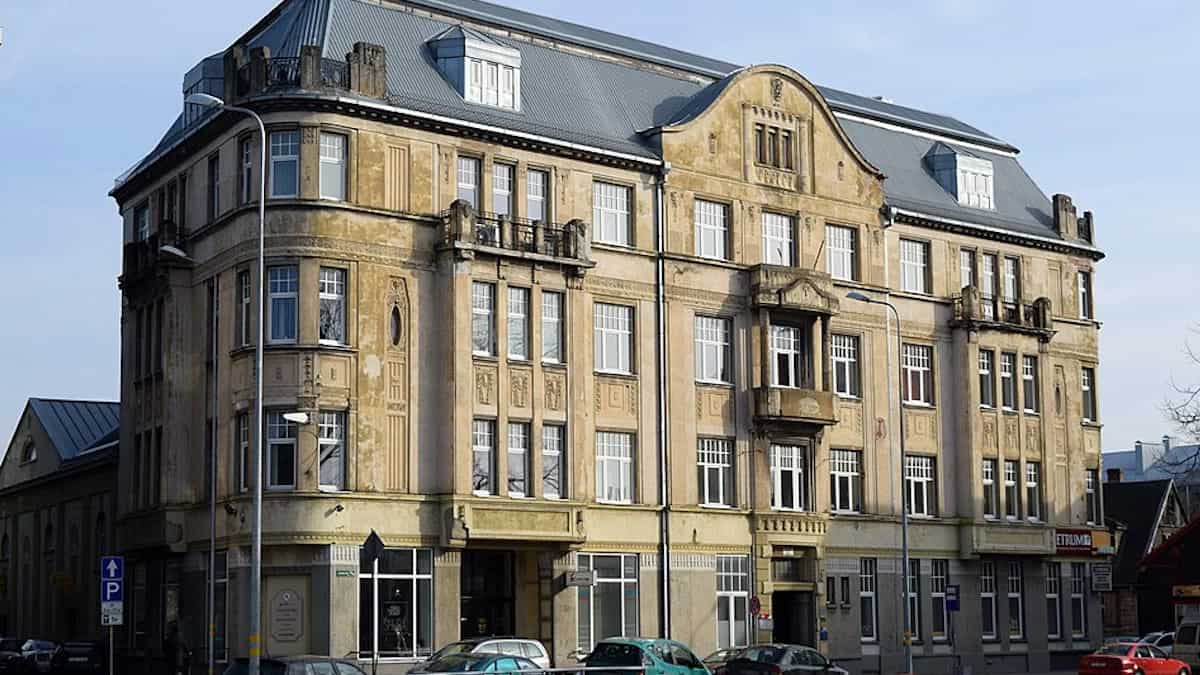
“At Ease!” — a contemporary art show curated by Ieva Rubeze — opened on 29 May in an unusual location: the shop windows and storefronts of 36/38 Graudu Street in the centre of Liepāja. It runs until 29 June, free of charge, and forms part of the Liepāja 2027 European Capital of Culture programme.
The setting is deliberate. Graudu Street is a street where pedestrians often walk in central Liepāja — the kind of place locals walk past on their way somewhere else. Putting art in the storefronts rather than a gallery means the exhibition meets people who weren’t looking for it.
Pēteris Rubezis has created a new piece specifically for the show: “Dūmi Kāpās” (Smoke in the Dunes, 2026), an architectural installation described as beckoning visitors to engage rather than simply observe. It offers, in the curator’s framing, a space to reconcile one’s own thoughts — whatever that means to the person standing on the pavement outside.
Vita Liepiņa, who works across visual art and music, contributes two pieces: “Bez darba rokas meklē nedarbus” (Idle Hands Seek Idleness, 2025) and “Batika” (2024). Both explore crocheting — a rhythmic, cyclical, almost mechanical process. The intent is to demonstrate how repetitive physical work quietens the mind. It is not a new idea. It is a well-evidenced one.
Curator Ieva Rubeze describes the tension directly: “At Ease!” is a military command — an instruction to pause on the brink of inevitable. But it reads simultaneously as the kind of thing someone says to you at a party when you’re standing awkwardly. Relax. Be comfortable. You’re safe here.
“Like a manifesto,” Rubeze explains. “I choose peace, despite all the chaos.”
The exhibition positions itself as a meditation on the boundary between external disorder and internal stillness. Given the context — a Baltic city that spent decades under Soviet occupation, in a country that shares a border with Belarus and has Russia across the water — the idea of choosing peace as an act of will rather than a passive state carries weight that it might not carry elsewhere.
The (un)rest theme running through the entire Liepāja 2027 programme is visible here. Rest is not relaxation. It is a choice made in the middle of unrest.
The exhibition is part of CreArt 3.0 #stringing_together, a project under the EU’s Creative Europe programme through which 13 medium-sized European cities share contemporary art events each May. Liepāja is one of those cities.
The network matters beyond logistics. CreArt connects cities that don’t usually appear on the European arts circuit — places that are culturally significant but not obvious destinations. Liepāja fits that description well. The exhibition itself is modest in scale. Its position within a 13-city European initiative is not.
It is also worth noting what this kind of network does ahead of a Capital of Culture year. Artists and curators from 12 other cities now have a connection to Liepāja. Some of them will come back in 2027.
Liepāja is Latvia’s third city — about 70,000 people on the Baltic coast, sitting between the sea and Lake Liepāja, connected by a trading canal that’s been there since the city was known as Libau under the Russian and German empires. It has the oldest professional symphony orchestra in the Baltics, founded 1881, and a theatre tradition going back to 1907. It is also, somewhat unexpectedly, considered Latvia’s rock music capital — a reputation that came out of the Soviet era, when the city’s relative distance from Riga gave musicians more room to operate.
The Soviet military presence left a mark that is physical as well as cultural. The northern district of Karosta, a former naval base, sits partly derelict on the edge of the city. The experience of living with that history — of choosing what to preserve, what to repurpose, and what to leave to decay — is part of what makes the (un)rest theme resonate locally rather than just sound like a cultural programme concept written by a committee in Brussels.
An exhibition about choosing peace, staged in a city that has had to make that choice repeatedly and in concrete terms, is not a coincidence.
The European Capital of Culture is a designation awarded by the European Commission to cities that represent the diversity and depth of European cultural life. For 2027, three cities hold it: Liepāja (Latvia), Évora (Portugal), and České Budějovice (Czech Republic). Liepāja’s programme is called (un)rest — a name that does more work than most ECoC titles — and it runs from April to December 2027. Pre-programme events like “At Ease!” have been underway since the start of 2026.
The designation is not just about the programme year. It is about what a city builds during the preparation and what remains after the cameras leave.
The exhibition runs until 29 June 2026 at 36/38 Graudu Street, Liepāja. Entry is free. Liepāja is a three-hour drive or bus journey from Riga. For accommodation and practical information about visiting the city during the 2027 programme, liepajaguide.com has the full picture.
Sources: Official programme page — liepaja2027.lv · CreArt network · liepajaguide.com
Picture: Great Amber Concert Hall — —=XEON=—, CC BY-SA 3.0 via Wikimedia Commons.