Physical Address
304 North Cardinal St.
Dorchester Center, MA 02124
Physical Address
304 North Cardinal St.
Dorchester Center, MA 02124

European Capital of Culture 2027
European Capital of Culture 2027
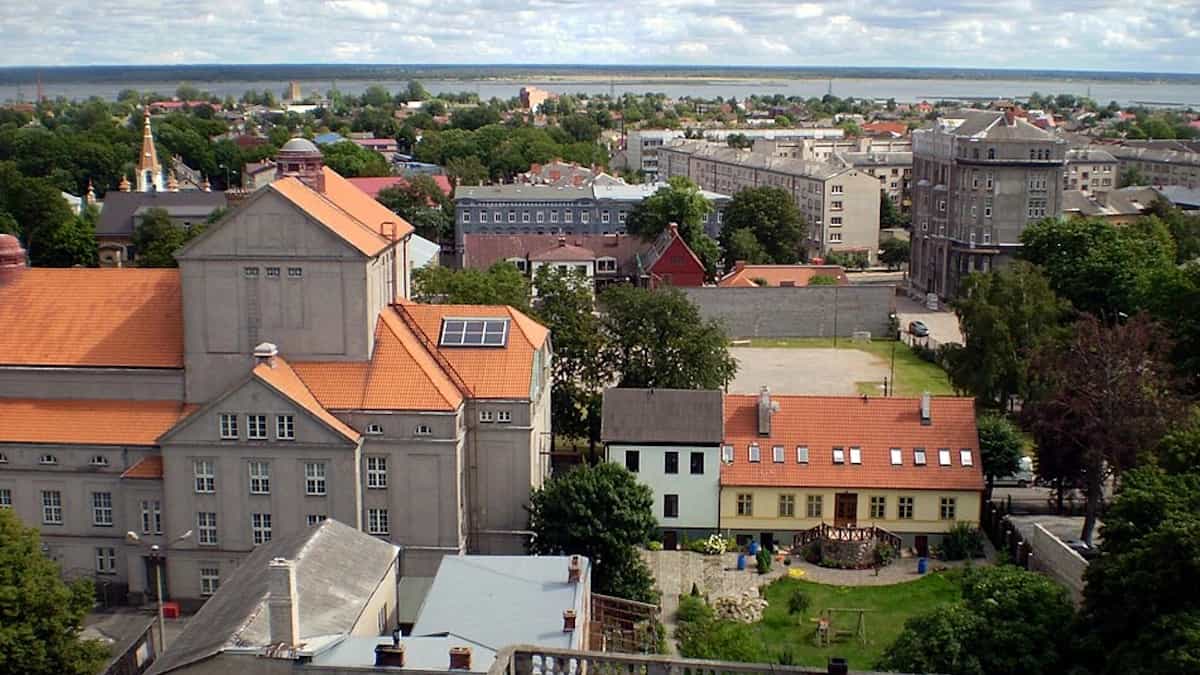
The European Capital of Culture designation does a lot of things. It generates press releases. It announces programme concepts. What it rarely explains is where things actually happen — the specific physical character of a city, what its stages are made of, what they were used for before the arts programmers arrived.
Liepāja’s answer to that question is more interesting than most.
The year’s 500-plus events are distributed across spaces that wouldn’t coexist in quite this configuration anywhere else in Europe: a concert hall designed around the visual logic of Baltic amber; a Soviet naval district covering a third of the city, closed to civilians until 1994; an organ with 7,000 original pipes that has never been rebuilt; a professional theatre operating in the same building since 1907.
These are not generic venues dressed up for a cultural year. They are, in ways that matter, what the (un)rest programme is actually about.
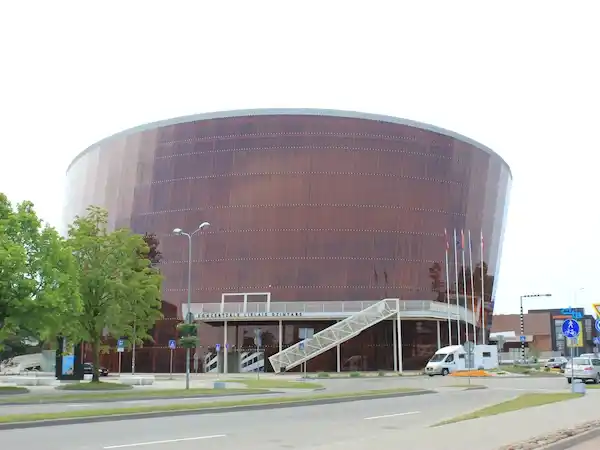
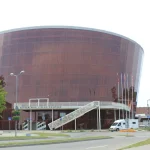
The Great Amber Concert Hall — Lielais Dzintars in Latvian — opened in Liepāja in 2015 and is the city’s most immediately legible architectural statement about itself. Austrian architect Volker Giencke took Baltic amber, the translucent resin that washes up on beaches along this stretch of coastline, as his concept. The building is a cone-shaped, slightly contorted structure with an amber-tinted facade and 14 mirror-finished tubes that draw natural light through the building and warm the interior.
It covers 14,126 square metres across eight floors. Inside, there are three distinct performance spaces: the Great Hall seats 1,000 and uses a terraced vineyard layout — the same acoustic principle applied in several of Europe’s finest concert halls — producing reverberation times of 1.8 to 2.0 seconds; the Chamber Hall seats 200; the Experimental Stage accommodates 120. The home of the Liepāja Symphony Orchestra, the oldest in the Baltic States, it was built to give that ensemble an acoustically serious room for the first time.
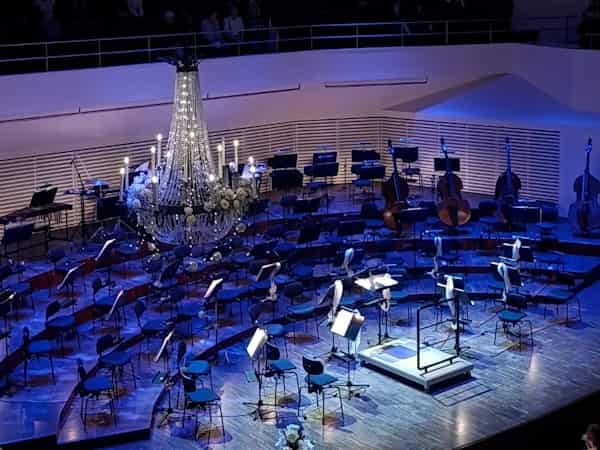
In 2027, the Great Amber is where the programme’s highest-profile international commissions land. Sun & Sea — the Lithuanian opera-performance that won the Golden Lion at the 2019 Venice Biennale — makes its Latvian debut at the Great Amber between 8 and 11 April. Europa Cantat, the major European amateur choir festival, comes to Liepāja for the week of 9–15 August, bringing around 3,000 singers. Malian vocalist Oumou Sangaré performs in October as part of the hall’s ongoing international series.
The Great Amber and its full 2027 programme are covered in depth in our dedicated venue profile.
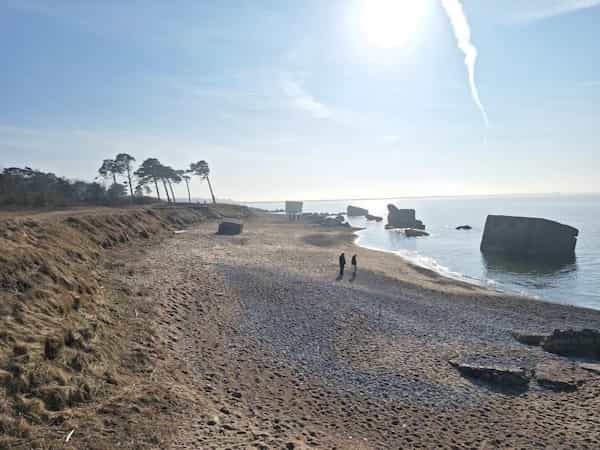
Karosta is the part of Liepāja that stops visitors mid-sentence. It occupies roughly a third of the city’s territory — not a neighbourhood in any conventional sense, but a complete parallel city within the city.
The Russian Empire built it at the turn of the 19th and 20th centuries as a naval base — briefly the largest military facility ever constructed on Baltic soil. The Russian fleet left. The Germans came. The Soviets sealed it from civilian life until 1994.
What that history produced is a place of extreme architectural contrast: Tsarist naval buildings — grand, symmetrical, built to impress — sitting beside Soviet housing blocks, beside a functioning Orthodox cathedral, beside the Northern Forts.
The forts are the part of Karosta that people find hardest to describe. They are coastal fortifications from which the Baltic has been reclaiming the foundations for over a century. Several structures are partially submerged. Some lean.
The effect at low tide, with the sea running over exposed ironwork, is somewhere between haunting and absurd.
Karosta has had an active arts presence for years. The K@2 Culture and Information Centre has been running programming for local young people and visiting artists for well over a decade. The Redan area already displays murals and installations from previous Karosta Festivals.
Karosta Prison offers an experience involving actors playing Soviet-era guards that is, depending on your disposition, either fascinating or exactly what it sounds like.
In 2027, the Port Paradox programme strand uses Karosta extensively — the Latvian New Theatre Institute’s Karosta–Radosta series, new site-specific work around the forts, community-led projects rooted in the district’s identity.
Port Paradox is probably the programme strand that fits its venue most precisely. The name describes Liepāja’s contradictions, and Karosta is where those contradictions are most visible.
A full profile of Karosta as a cultural venue — the history, the specific spaces, what the 2027 programme involves — is covered separately on this site.

Liepāja’s Holy Trinity Cathedral contains the world’s largest mechanical organ that has never been rebuilt. It was built with 131 stops, four manuals, and over 7,000 pipes. It held the title of world’s largest until 1912, when an instrument in Hamburg surpassed it.
What distinguishes it now is the word unmodified. The pipes are original, built by the organ-maker Contius in the nineteenth century. No replacements. No modern additions. No upgrade programme. It is the only instrument of this scale anywhere in the world to have remained structurally unchanged.
The cathedral is not a museum. The organ is played — it is part of an active church building in regular use. For a programme built around the tension between change and preservation, a 140-year-old instrument in working order makes an argument that no press release could.
The organ’s full history and its role in the 2027 programme are the subject of a separate article on this site.
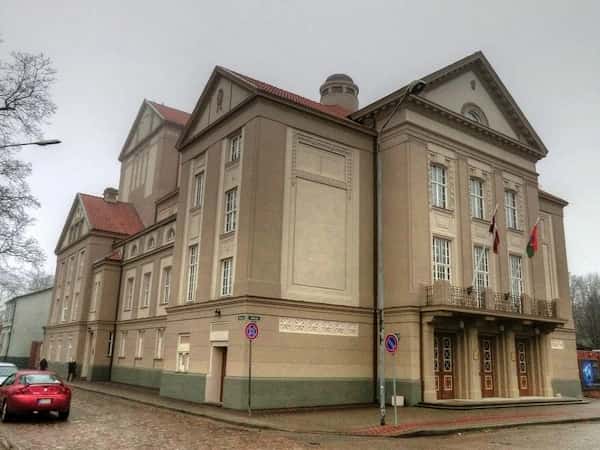
The Liepāja Theatre was founded in 1907, making it the oldest continuously operating professional theatre in Latvia. The building sits in the city centre, within a few minutes’ walk of both the Great Amber and the cathedral.
The same building housed the Liepāja Opera for part of the last century, before that moved on. The theatre has kept running through everything.
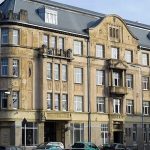
The exterior is Art Nouveau — one of more than 70 surviving Art Nouveau structures in the city, many still in residential use, some in various states of restoration. The theatre runs a full season and hosts both local productions and visiting companies.
It is part of the 2027 framework without being its centrepiece. In a city where the concert hall and the Soviet naval base tend to take the photographs, the theatre is where the programme’s quieter dramatic work happens.
A dedicated profile of the Liepāja Theatre and its 2027 programming is in preparation on this site.
The Liepāja 2027 programme is not confined to named venues. Around 60% of the year’s events take place in Liepāja itself; the remaining 40% spread across South Kurzeme and the Kuldīga region — formal partners in the programme, not peripheral add-ons.
Kuldīga holds UNESCO World Heritage status for its old town. The Suiti Cultural Space in Alsunga carries a UNESCO Intangible Cultural Heritage designation. Both bring their own weight to the programme.
Within Liepāja, the programme explicitly uses what the official documents describe as “downgraded areas and new cultural venues” — spaces outside the established cultural infrastructure. The Illuminated Liepāja festival of lights returns in 2027 with new nocturnal urban installations by Japanese and Finnish artists, using the city itself as the canvas after dark.
The opening night on 23 January 2027 involves eleven separate events across different locations, beginning at 20:00. The programme starts dispersed — which is probably the right way to start a year specifically about not concentrating everything in the obvious places.
Liepāja is Latvia’s third-largest city — around 70,000 residents, on the Baltic coast, positioned between the sea and Lake Liepāja, joined by the Trade Canal. It is not the city most people outside Latvia would name if asked to identify a major Baltic cultural centre. That was, in part, the point of the application.
The city carries several cultural identities simultaneously. The Liepāja Symphony Orchestra has roots going back to 1881, when the city’s first philharmonic was founded — the oldest in the Baltic States. The Liepāja Theatre has been running since 1907.
And yet Liepāja is also — without contradiction — the city that produced several of Latvia’s most significant rock bands and hosts the country’s largest music festival.
Summer Sound draws over 40,000 attendees. Liepāja has a general reputation for being louder and less concerned with its own image than Riga, which is either a drawback or the whole point, depending on who you ask.
The Soviet layer at Karosta adds something else: a closed military district, sealed from its own city for decades, now open but not fully absorbed. The (un)rest theme makes more sense in Liepāja than it would in a city with a tidier history.
The European Capital of Culture designation is awarded by the European Commission to cities across the continent, typically three per year, with the aim of celebrating cultural diversity and exchange.
In 2027, the title is held jointly by Liepāja, Évora in Portugal, and České Budějovice in the Czech Republic. Liepāja is the second Latvian city to hold it, after Riga in 2014.
The Liepāja programme — named (un)rest and structured around five thematic strands (European Dream, Port Paradox, New Eyes, Deliberate Modesty, Creative Foresight) — runs throughout 2027, with more than 500 events confirmed. The official programme and full event listings are at liepaja2027.lv.
Liepāja is a three-hour drive or bus journey from Riga; LUX Express runs regular services. The Stena Line ferry connects the city with Travemünde in Germany several times a week — useful for visitors arriving from Western Europe. The programme opens officially on 23 January 2027.
For accommodation options, practical travel information, and everything else you need to plan a visit around the 2027 events, liepajaguide.com covers the logistics side in full.
Picture: Great Amber Concert Hall — Andrzej Otrębski, CC BY-SA 4.0 via Wikimedia Commons.
Picture: Liepaja Theatre — —=XEON=—, CC BY-SA 3.0 via Wikimedia Commons.
Picture: Dzintars Lielais stage © Megija Zvereva – Not for sharing