Physical Address
304 North Cardinal St.
Dorchester Center, MA 02124
Physical Address
304 North Cardinal St.
Dorchester Center, MA 02124

European Capital of Culture 2027
European Capital of Culture 2027
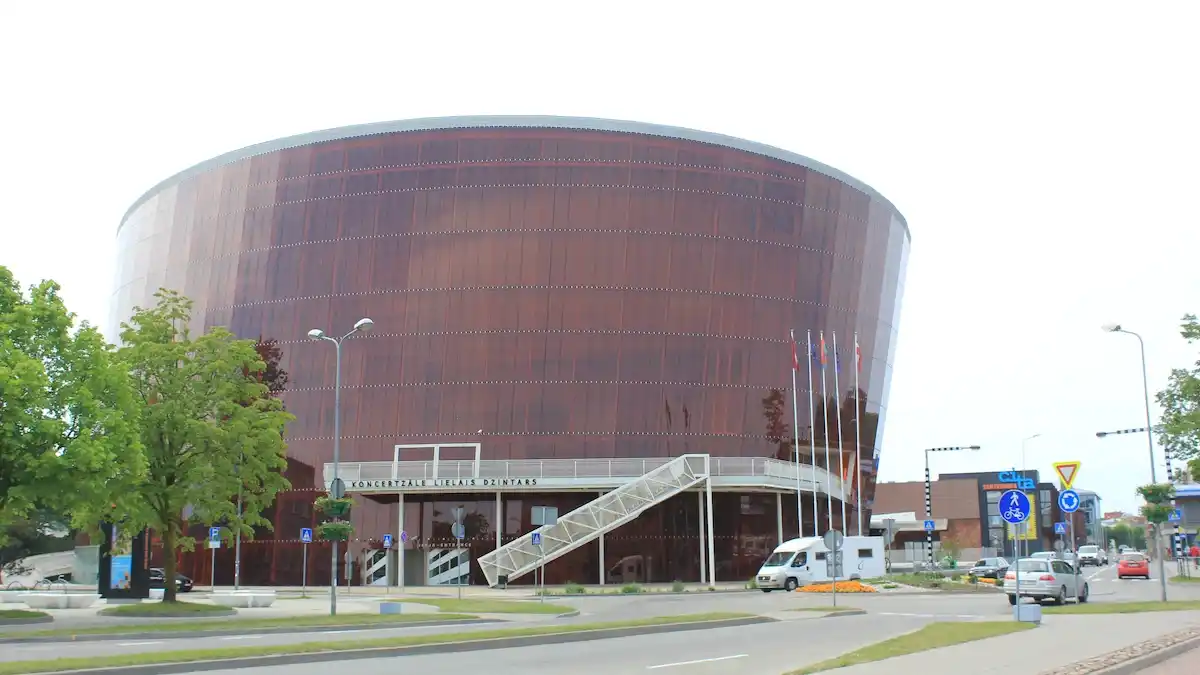
The Great Amber Concert Hall opened in 2015. Liepāja had been trying to build it since 1896. That gap — 119 years between the city council’s decision and the ribbon-cutting — tells you something about both the ambition of the project and the obstacles that stood in its way. Wars. Soviet occupation. Economic collapse. The building that finally went up was worth the wait.
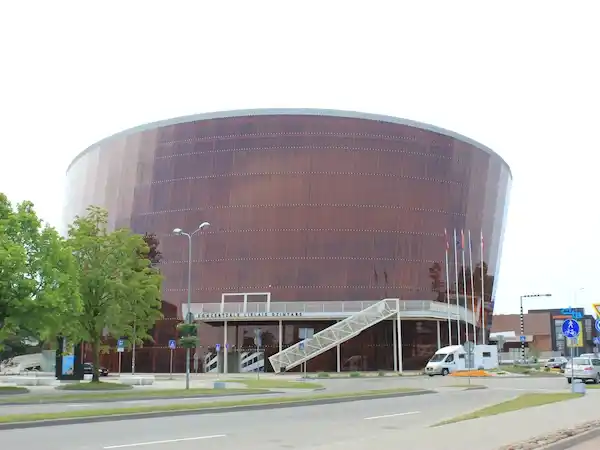
Austrian architect Volker Giencke won a worldwide competition in 2003 with a concept that took amber — the fossilised resin found on Baltic beaches for millennia — as its structural and visual logic. The result is a cone-shaped, slightly contorted form wrapped in amber-coloured glazed panels. At night, the interior glows through the glass. During the day, fourteen mirror-finished reflective tubes channel Baltic light into the main hall.
The acoustics were developed by world expert Karlheinz Müller on the principle of an oval, terraced vineyard — the same design logic that underpins some of the best concert halls in the world. The Great Hall seats 1,000. There is also a Chamber Hall with 200 seats and an Experimental Stage with 120. It is the largest concert hall in the Baltic states.
The Liepāja Symphony Orchestra was founded in 1881 — making it the oldest professional symphony orchestra in the Baltic states. For most of its existence, it performed without a dedicated home. That is the strange situation of Liepāja: a city with deep musical heritage and nowhere worthy of it for over a century.
The Great Amber became the orchestra’s permanent home when it opened in 2015. The relationship between the hall and its resident ensemble is central to understanding what kind of cultural venue this is. It is not a civic prestige project that hosts a rotating cast of visiting acts. It has an identity built around continuity, and the orchestra is the anchor of that identity.
The “Stars in Amber” international concert series, which the hall runs annually, has established the venue as a regional draw for serious classical music audiences from Latvia and beyond. The series brings international soloists and ensembles to the Great Hall — performers who, until the building existed, had no obvious reason to come to Liepāja.
The European Capital of Culture designation puts the Great Amber at the centre of something it was always designed to host but rarely had occasion to: genuinely international attention.
The hall’s programming for the (un)rest year runs from the operatic to the experimental. Its role in the ECoC programme is not simply as a prestige venue for flagship events — though it will host those — but as the cultural anchor around which more adventurous programming orbits. The Experimental Stage and Chamber Hall carry events the Great Hall cannot, by virtue of scale and format.
Staff at the hall have been trained in cultural sustainability and community engagement through a partnership with Icelandic expert Vigdis Jakobsdottir — an indication that the institution is thinking about 2027 not as a one-year windfall but as an inflection point for how it operates long-term.
The building turned ten in 2025. The anniversary festival — five programmes across October and November, culminating in a performance of Schoenberg’s Gurre-Lieder with more than 250 musicians on stage — was both a celebration and a statement of intent. A city with a concert hall like this should not be obscure. In 2027, it won’t be.
Liepāja is Latvia’s third city, on the Baltic coast, population around 70,000. It sits between the sea and a large freshwater lake, with wind moving through it constantly — the city is exposed in a way that defines its character. Latvians know Liepāja as the rock capital of the country; it has a live music culture that runs deeper than its size would suggest.
The Great Amber Concert Hall stands on the eastern bank of the Tirdzniecības Canal, close to the city centre. The amber-coloured glass reads differently at different times of day — dark and dense in overcast Baltic light, warm and luminous when the sun catches it from the west. The architect’s intention was a building that changes as you look at it.
The city’s musical life before the hall had a different centre of gravity: the Liepāja Theatre, one of the oldest in Latvia, and the symphony orchestra performing in spaces not designed for it. The hall changed that. What the ECoC designation does is amplify what the hall has already established.
The European Capital of Culture designation is awarded by the European Commission to cities across the continent. It runs for one calendar year and is designed to bring international attention to European cities beyond the well-known cultural capitals. Liepāja holds it for 2027, alongside Évora in Portugal and České Budějovice in the Czech Republic. The programme is called (un)rest — a theme that makes particular sense for a city with Liepāja’s Soviet-era military history and its ongoing negotiation of that legacy. The programme runs from April to December 2027.
Liepāja is a three-hour drive or bus journey from Riga. Tickets for events at the Great Amber Concert Hall are available through Biļešu Paradīze. For accommodation, practical travel information, and everything else you need to plan a visit around the 2027 programme, liepajaguide.com has the full picture.Sources: lielaisdzintars.lv · liepaja2027.lv · ArchDaily · EU Regional Policy
Picture: Great Amber Concert Hall — Andrzej Otrębski, CC BY-SA 4.0 via Wikimedia Commons.



The architecture of the Amber Concert Hall looks pretty unique. Did you get to catch any performances there?
Yes, it’s a very modern concert hall and the acoustics are amazing.
[…] Great Amber Concert Hall — Lielais Dzintars in Latvian — opened in Liepāja in 2015 and is the city’s most […]